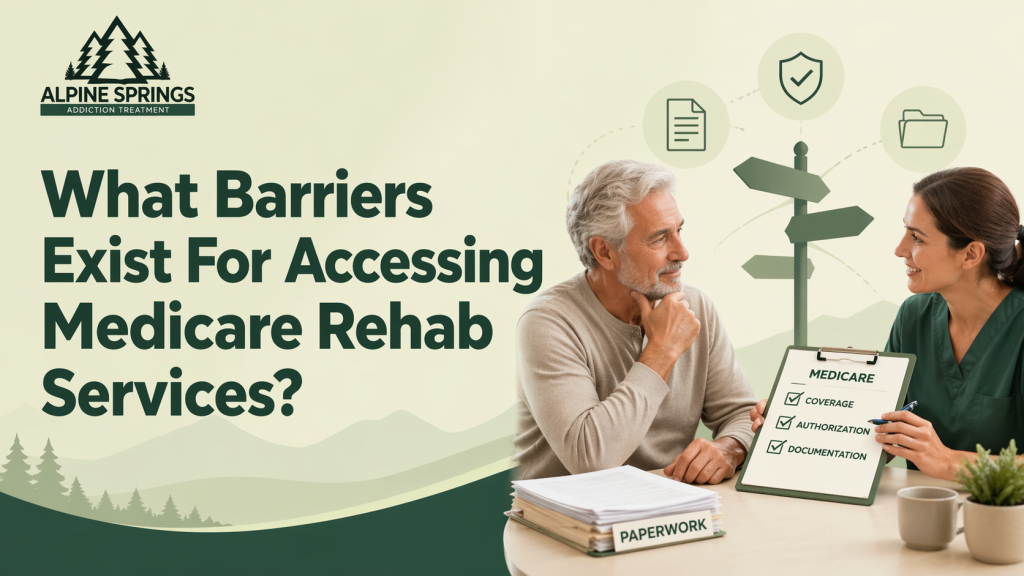

Medicare coverage can be confusing, especially when therapy, addiction treatment, outpatient care, and higher levels of care are involved. Alpine Springs Rehabilitation and Recovery can help you understand your next step.
Medicare may cover several types of rehabilitation therapies when they are medically necessary and provided in an eligible setting. Depending on the person’s needs, Medicare benefits may include physical therapy, occupational therapy, speech-language pathology, skilled nursing care, inpatient rehabilitation services, outpatient therapy, intensive outpatient mental health or substance use disorder care, and partial hospitalization.
The exact coverage depends on the person’s Medicare plan, medical necessity, provider eligibility, treatment setting, and whether any prior authorization or plan rules apply.
For addiction treatment and behavioral health care, Medicare may also cover certain counseling, therapy, medication management, opioid use disorder treatment services, outpatient substance use disorder treatment, intensive outpatient programs, and partial hospitalization services when requirements are met.
Why Medicare Rehab Coverage Can Be Confusing
Medicare rehab coverage can be confusing because the word “rehab” can mean different things.
It may refer to:
- Physical rehabilitation after an injury or surgery
- Skilled nursing facility rehab after hospitalization
- Inpatient rehabilitation after a serious illness or injury
- Mental health rehabilitation services
- Substance use disorder treatment
- Outpatient counseling or therapy
- Intensive outpatient treatment
- Partial hospitalization
Because these services may fall under different parts of Medicare, coverage can vary depending on whether the care is inpatient, outpatient, facility based, or provided by a specific type of provider.
Physical Therapy
Physical therapy helps restore, improve, maintain, or slow decline in physical movement and function. Medicare Part B may cover medically necessary outpatient physical therapy when a qualified provider certifies that it is needed.
Physical therapy may help with:
- Walking and mobility
- Balance
- Strength
- Pain related movement problems
- Recovery after injury
- Recovery after illness
- Recovery after surgery
- Fall prevention
- Maintaining current function
- Slowing physical decline
For someone recovering from addiction, physical therapy may also be relevant if the person has medical complications, injury, weakness, chronic pain, or functional decline that needs rehabilitation support.
Occupational Therapy
Occupational therapy helps people improve or maintain the skills needed for daily life. It may focus on practical tasks such as dressing, bathing, eating, home safety, coordination, adaptive equipment, and returning to daily routines.
Occupational therapy may help with:
- Daily living skills
- Fine motor coordination
- Home safety
- Energy conservation
- Adaptive equipment
- Cognitive or functional routines
- Recovery after injury, illness, or surgery
- Independence with personal care
In a broader rehab plan, occupational therapy can help people regain confidence and function during recovery.
Speech-Language Pathology Services
Speech-language pathology services, sometimes called speech therapy, may be covered when medically necessary. These services may help people with speech, language, communication, swallowing, or cognitive communication concerns.
Speech-language therapy may help after:
- Stroke
- Brain injury
- Neurological illness
- Swallowing difficulties
- Speech or language changes
- Cognitive communication problems
- Certain medical complications
In Medicare-covered inpatient rehabilitation or skilled nursing facility care, speech-language pathology may be included when needed to meet the person’s health goals.
Skilled Nursing Care
Skilled nursing care may be covered in a skilled nursing facility when the person meets Medicare’s eligibility rules. Skilled care is care that must be safely and effectively performed by, or under the supervision of, trained professionals.
Skilled nursing care may include:
- Medication management
- Wound care
- Monitoring medical conditions
- IV medications or fluids when appropriate
- Care coordination
- Observation and assessment
- Support after hospitalization
- Rehabilitation nursing
Skilled nursing facility care is generally short term and may include therapy services such as physical therapy, occupational therapy, and speech-language pathology when medically necessary.
Inpatient Rehabilitation Services
Inpatient rehabilitation may be covered when a person is recovering from a serious surgery, illness, or injury and needs intensive rehabilitation therapy, physician supervision, and coordinated care.
Medicare-covered inpatient rehabilitation care may include:
- Physical therapy
- Occupational therapy
- Speech-language pathology
- Nursing services
- Prescription drugs
- Meals
- A semi-private room
- Other hospital services and supplies
This level of care is usually for people who need a more intensive rehabilitation program and ongoing medical oversight.
Outpatient Therapy Services
Medicare may cover outpatient therapy services when they are medically necessary. Outpatient therapy may be appropriate when someone does not need inpatient care or skilled nursing facility care but still needs treatment to improve or maintain function.
Outpatient therapy may include:
- Physical therapy
- Occupational therapy
- Speech-language pathology
- Counseling or psychotherapy
- Substance use disorder treatment services
- Mental health services
- Medication management when appropriate
Outpatient care can be an important part of continuing recovery after a higher level of treatment ends.
Counseling and Psychotherapy
For mental health and substance use disorder treatment, Medicare may cover counseling and psychotherapy in eligible settings. These services may help diagnose and treat mental health conditions, substance use disorders, depression, anxiety, trauma, grief, and related concerns.
Counseling may include:
- Individual therapy
- Group therapy
- Family counseling when appropriate
- Behavioral therapy
- Substance use counseling
- Relapse prevention counseling
- Mental health therapy
For addiction recovery, counseling is often one of the core services that helps people understand triggers, build coping skills, and create a relapse prevention plan.
Intensive Outpatient Program Services
Medicare Part B may cover intensive outpatient program services for mental health conditions, including substance use disorders, when the person meets requirements.
An intensive outpatient program, often called IOP, is more structured than weekly therapy but less intensive than inpatient or partial hospitalization care.
IOP services may include:
- Group therapy
- Individual therapy
- Mental health education
- Medication management
- Substance use disorder counseling
- Recovery planning
- Structured therapeutic programming
This can be helpful for people who need more support than standard outpatient therapy but do not require inpatient hospitalization.
Partial Hospitalization Services
Partial hospitalization is a higher level of outpatient behavioral health care. It may be used when someone needs full-day structured treatment but does not require 24 hour inpatient hospitalization.
Partial hospitalization may include:
- Therapy
- Psychiatric services
- Medication management
- Group treatment
- Substance use disorder treatment support
- Mental health education
- Care coordination
- Crisis prevention planning
Medicare may cover partial hospitalization services when requirements are met and the care is provided through an eligible hospital outpatient department or community mental health center.
Opioid Use Disorder Treatment Services
Medicare may cover certain opioid use disorder treatment services through eligible opioid treatment programs. These services may include medication, counseling, therapy, toxicology testing, intake activities, periodic assessments, and care coordination when medically appropriate.
For opioid use disorder, medication may be part of treatment, but it is usually most effective as part of a broader plan that includes counseling, monitoring, and recovery support.
Medication Management
Medication management may be part of covered care in several Medicare-covered settings. This may include medications used during inpatient care, psychiatric medications, medications for opioid use disorder, and certain outpatient prescription medications depending on the person’s Part D or Medicare Advantage drug coverage.
Medication management may support:
- Mental health stability
- Craving reduction
- Withdrawal support
- Opioid use disorder treatment
- Alcohol use disorder treatment when covered
- Co-occurring mental health needs
- Continuity of care after discharge
Coverage depends on the medication, provider, setting, and plan rules.
What Medicare May Not Cover
Medicare coverage has limits. Services may be denied if they are not medically necessary, not properly documented, not provided by an eligible provider, or not covered by the person’s specific plan.
Medicare may not cover:
- Custodial care by itself
- Long-term room and board
- Private duty nursing
- Personal items
- Services provided too frequently
- Services that do not meet medical necessity rules
- Care from providers not accepted by the plan
- Certain luxury amenities
- Non-covered alternative therapies
Families should always ask the provider and Medicare plan what is actually covered.
Questions to Ask Before Starting Rehab Therapy
Before beginning rehabilitation therapy under Medicare, ask:
- Which part of Medicare covers this service?
- Is this inpatient, outpatient, SNF, IOP, or partial hospitalization care?
- Does the provider accept Medicare?
- Is the service medically necessary and documented?
- Does a doctor or qualified provider need to certify the need?
- Are there prior authorization requirements?
- What will the out of pocket cost be?
- Does my Medicare Advantage plan have network rules?
- What happens if coverage is denied?
- What aftercare services are available?
These questions can help prevent confusion and reduce unexpected costs.
Medicare Advantage Coverage May Differ
Medicare Advantage plans must cover many of the same medically necessary services as Original Medicare, but they may have different networks, authorization requirements, copays, referrals, and plan rules.
If someone has a Medicare Advantage plan, they should contact the plan directly or ask the treatment provider to verify benefits before starting care.
Getting Help Understanding Medicare Rehab Benefits
Medicare may cover many rehabilitation therapies, including physical therapy, occupational therapy, speech-language pathology, skilled nursing care, inpatient rehabilitation, outpatient therapy, counseling, intensive outpatient programs, partial hospitalization, and certain substance use disorder treatment services.
The most important factors are medical necessity, the level of care, documentation, provider eligibility, and the person’s specific Medicare coverage.
At Alpine Springs Rehabilitation and Recovery, families often have questions about Medicare, insurance coverage, and treatment options. Our team can help explain available levels of care and what to ask when reviewing benefits.
To speak with someone about treatment options, call Alpine Springs at 814-818-0002.
FAQ Section
Which rehabilitation therapies are included in Medicare benefits?
Medicare may cover physical therapy, occupational therapy, speech-language pathology, skilled nursing care, inpatient rehabilitation services, outpatient therapy, counseling, intensive outpatient programs, partial hospitalization, and certain substance use disorder treatment services when requirements are met.
Does Medicare cover physical therapy?
Yes. Medicare Part B may cover medically necessary outpatient physical therapy when a doctor or qualified provider certifies that it is needed.
Does Medicare cover occupational therapy?
Medicare may cover occupational therapy when it is medically necessary and provided by an eligible provider in a covered setting.
Does Medicare cover addiction counseling?
Medicare may cover certain outpatient services that are part of substance use disorder treatment, including counseling and therapy, when provided by eligible providers and when coverage requirements are met.
Does Medicare cover intensive outpatient treatment?
Medicare Part B may cover intensive outpatient program services for mental health conditions, including substance use disorders, when the person’s care plan shows that this level of therapeutic service is needed.